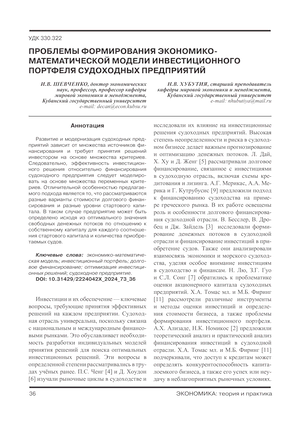
Problems of formation of economic-mathematical model of investment portfolio of shipping enterprises
Abstract
The development and modernization of shipping enterprises depends on multiple sources of financing and requires investor decisions based on multiple criteria. Therefore, the effectiveness of an investment decision regarding the financing of a shipping business should be modeled on the basis of multiple variable criteria. The distinctive feature of the approach is that different options for the cost of debt financing and different levels of starting capital are considered. In this case, the enterprise can be determined based on the optimal value of free cash flows to equity capital for each ratio of starting capital and the number of ships purchased.
Keywords
economic and mathematical model, investment portfolio, debt financing, optimization of investment decisions, shipping company
References
- Клячко Л.М. Оценка развития морской деятельности приморских субъектов Российской Федерации // Россия: тенденции и перспективы развития: ежегодник: материалы XIX Национальной науч. конф. с междунар. участием / отв. ред. В.И. Герасимов. Вып. 15, ч. 1. М.: ИНИОН РАН, 2020. С. 681—687.
- Alizadeh A.H., Nomikos N.K. Investment timing and trading strategies in the sale and purchase market for ships // Transportation Research Part B: Methodological. 2007. Vol. 41(1). P. 126—143.
- Bessler W., Drobetz W., Seidel J. Ship funds as a new asset class: An empirical analysis of the relationship between spot and forward prices in freight markets // Journal of Asset Management. 2008. Vol. 9 (2). P. 102—120.
- Cheng P.C. Financial management in the shipping industry. Centreville: Cornell Maritime Press, 1979.
- Dai L., Hu H., Zhang D. An empirical analysis of freight rate and vessel price volatility transmission in global dry bulk shipping market // Journal of Traffic and Transportation Engineering (English Edition). 2015. Vol. 2 (5). P. 353—361.
- Hawdon D. Tanker freight rates in the short and long run // Applied Economics. 1978. Vol. 10 (3). P. 203—218.
- Liu N., Guo Z.G., Song X.Q. Prediction of China’s export container freight index based on RBF neural network // The 6th International Conference on Transportation Information and Safety (ICTIS 2021). Wuhan, 2021. P. 127—135.
- Lun Y.H.V., Quaddus M.A. An empirical model of the bulk shipping market // International Journal of Shipping and Transport Logistics. 2009. Vol. 1 (1). P. 37.
- Merikas A.G., Merika A.A., Koutroubousis G. Modelling the investment decision of the entrepreneur in the tanker sector: choosing between a second-hand vessel and a newly built one // Maritime Policy & Management. 2008. Vol. 35 (5). P. 433—447.
- Müller D., Te Y.F. Insurance premium optimization using motor insurance policies-A business growth classification approach // 2017 IEEE International Conference on BigData (IEEE BigData 2017). Boston, 2017. P. 4154—4158.
- Thomas H.A., Jr., Fiering M.B. Mathematical synthesis of streamflow sequences for the analysis of river basins by simulation // Design of Water-Resource Systems: New Techniques for Relating Economic Objectives, Engineering Analysis, and Governmental Planning. Cambridge: Harvard University Press, 1962. P. 459—493.
Statistics
Download data is not yet available.
Article Sidebar
Article Details
Issue
Section
Investments
Publication History
Published
2024-03-20
How to Cite
[1]
Shevchenko I.V., Khubutiya N.V. Problems of formation of economic-mathematical model of investment portfolio of shipping enterprises // Economics: Theory and Practice. 2024. No 1 (73). С. 36–45. DOI: 10.31429/2224042X_2024_73_36
License
Copyright (c) 2024 I. V. Shevchenko, N. V. Khubutiya

This work is licensed under a Creative Commons Attribution 4.0 International License.